The Complete Guide
Custom Made BBQ Covers — The Australian Owner's Complete Guide
A BBQ is one of the more expensive pieces of equipment in most Australian backyards — and one of the most exposed to weather. This guide covers everything you need to know before ordering a custom cover for your outdoor BBQ.
Why BBQ covers fail
Most off-the-shelf BBQ covers fail for the same two reasons: the wrong size and the wrong material.
Standard covers come in a handful of fixed widths — typically 60 cm, 90 cm, 120 cm, 150 cm, and occasionally 180 cm. The problem is that BBQs are made in hundreds of configurations. A four-burner from one brand might be 105 cm wide. Another brand's five-burner might be 132 cm. Neither fits neatly into the standard range. So you end up with a cover that either stops short of the edges, leaving the bottom of the unit exposed, or is so much wider than the BBQ that it pools water in the folds and flaps in any kind of breeze.
The second problem is material. Budget covers are made from polyester that is printed or dyed on the surface, not through the fibre. Within a season of Australian UV they start to fade, then crack, then stop being waterproof at the spots where the coating has broken down. The cover starts leaking exactly where water tends to collect.
A custom-made cover made from the right fabric fixes both problems.
The three measurements that matter
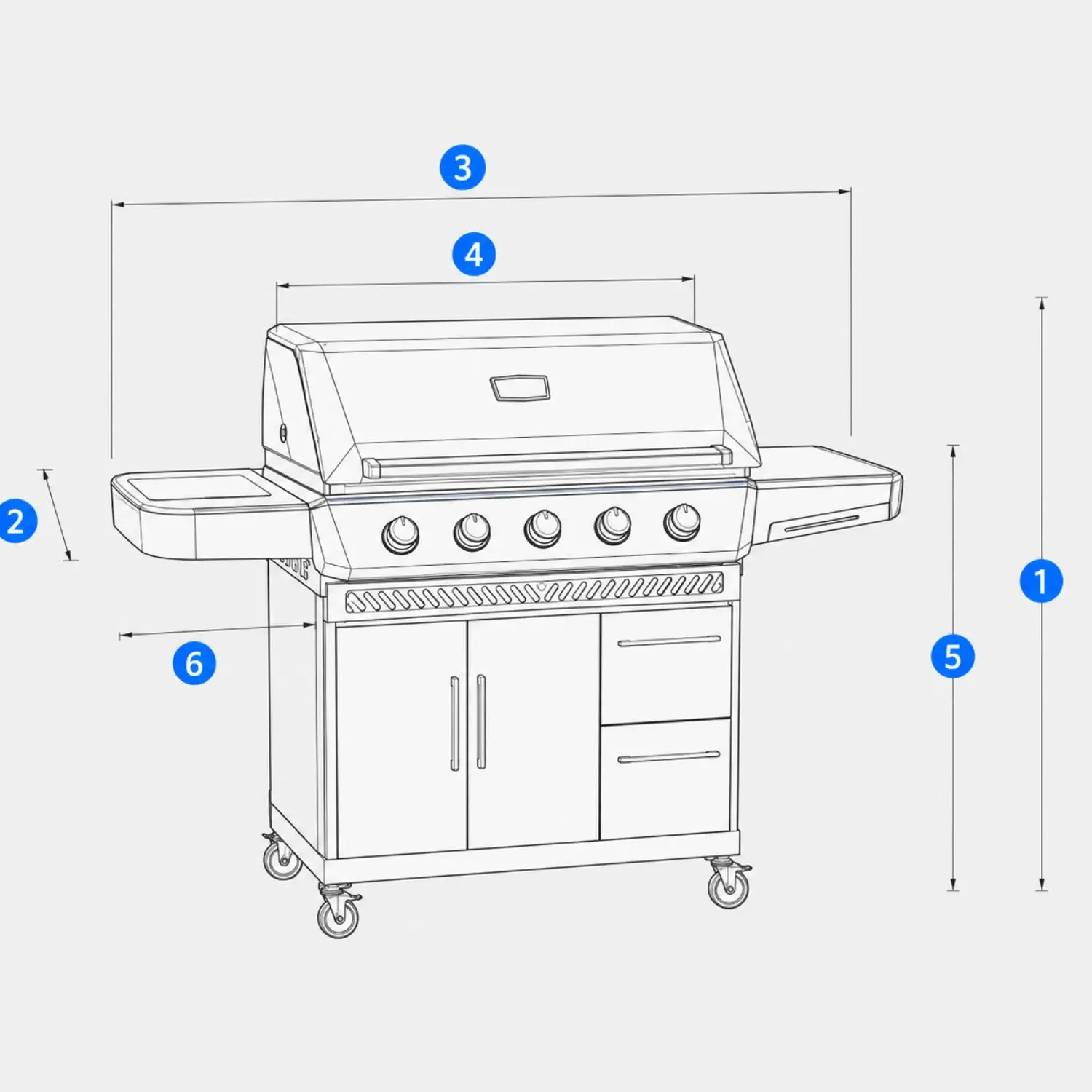
A rectangular BBQ cover needs just three dimensions. Getting them right takes about two minutes with a tape measure.
1. Width
Measure the widest point of the BBQ from outside edge to outside edge, at the level of the widest point. On most BBQs this is at the body of the unit — but if your model has fixed side shelves that extend beyond the body, measure to the outer edge of those shelves.
If your side shelves fold down and you normally store the BBQ with them folded, measure with them folded. The cover should fit the way you actually leave the unit, not in every possible configuration.
2. Depth
Measure front to back at the deepest point. On most BBQs this is straightforward — the unit is a consistent depth front to back. On some models there are rear handles or exhaust stacks that protrude slightly. Include those if they extend more than a couple of centimetres beyond the main body.
3. Height
Measure from the floor to the top of the lid in its fully closed position. If your BBQ sits on a trolley or a fixed pedestal base, start the measurement from the floor — the cover goes over the entire unit. Do not measure just the BBQ body separately from the trolley.
Why fabric quality matters more for BBQ covers
BBQ covers deal with a challenge that other furniture covers do not: heat cycles. A BBQ that has been used and then covered while still warm puts the cover through repeated expansion and contraction cycles. A waterproof coating that cannot flex will crack along the fold lines within a season.
The other challenge is grease and fat deposits. Even when the BBQ is cleaned before covering, residue builds up on the outside of the unit over time and transfers to the inside of the cover.
Solution-dyed polyester face fabric
The face fabric is solution-dyed polyester at 200gsm. Solution-dyed means the pigment is added to the polymer before it is formed into fibres, so the colour runs all the way through each thread. That is what makes it fade-resistant in Australian UV conditions, where surface-dyed fabrics will go noticeably patchy within two or three seasons.
At 200gsm the fabric is heavy enough to feel substantial and hold its shape over the BBQ in wind, but light enough that one person can put it on and take it off without a struggle.
Polyurethane waterproof undercoating
The underside carries a flexible polyurethane (PU) waterproof coating. PU stays flexible through heat cycles and will not crack at fold lines the way PVC coatings do. It also does not get sticky in heat, which matters when a cover is left on a BBQ in direct sun for days at a time.
UV stabilisation
The fabric and coating are UV stabilised, which means the molecular structure is protected against the photodegradation that causes outdoor materials to chalk, crack, and fail. Non-stabilised materials can start to fail within eighteen months in Australian conditions. A stabilised fabric and coating combination will typically give five to seven years of useful life in full sun.
Caring for your BBQ cover
Rinse the outside with a garden hose every couple of months, especially after any period of heavy rain where water has been sitting on it or after a dusty spell. Shake off any loose debris before putting it on — grit caught between the cover and the BBQ lid can scratch both surfaces over time.
If grease or fat transfers to the inside of the cover, spot-clean with warm soapy water and allow to air dry fully before putting it back on. Do not machine wash — the agitation breaks down the waterproof coating in a single cycle. Do not fold the cover in the same place every time when storing it; vary the fold lines to avoid repeated stress on any one section of the coating.