The Complete Guide
Custom Made Built-In BBQ Covers — The Australian Owner's Complete Guide
A built-in BBQ is one of the more considered purchases in an outdoor kitchen, and one of the hardest things to find a good cover for. This guide walks through everything you need to know before ordering a custom cover for your built-in BBQ head unit.
Why generic covers do not work for built-in BBQs
The core problem is that standard BBQ covers are designed for freestanding units on trolleys. They are made wide enough to clear a trolley base, long in the skirt so they drop to ground level, and sized in widths that match common freestanding models.
A built-in BBQ head has a completely different geometry. It sits in a bench cutout, flush with the surrounding surface. The cover only needs to go over the head unit itself, not a trolley or a wide freestanding base. When you put a standard cover on a built-in BBQ it either sits too wide and drapes awkwardly over the bench, or it is too large in all directions and ends up being held in place by nothing in particular.
The only practical solution is a cover made to the exact footprint of your BBQ head.
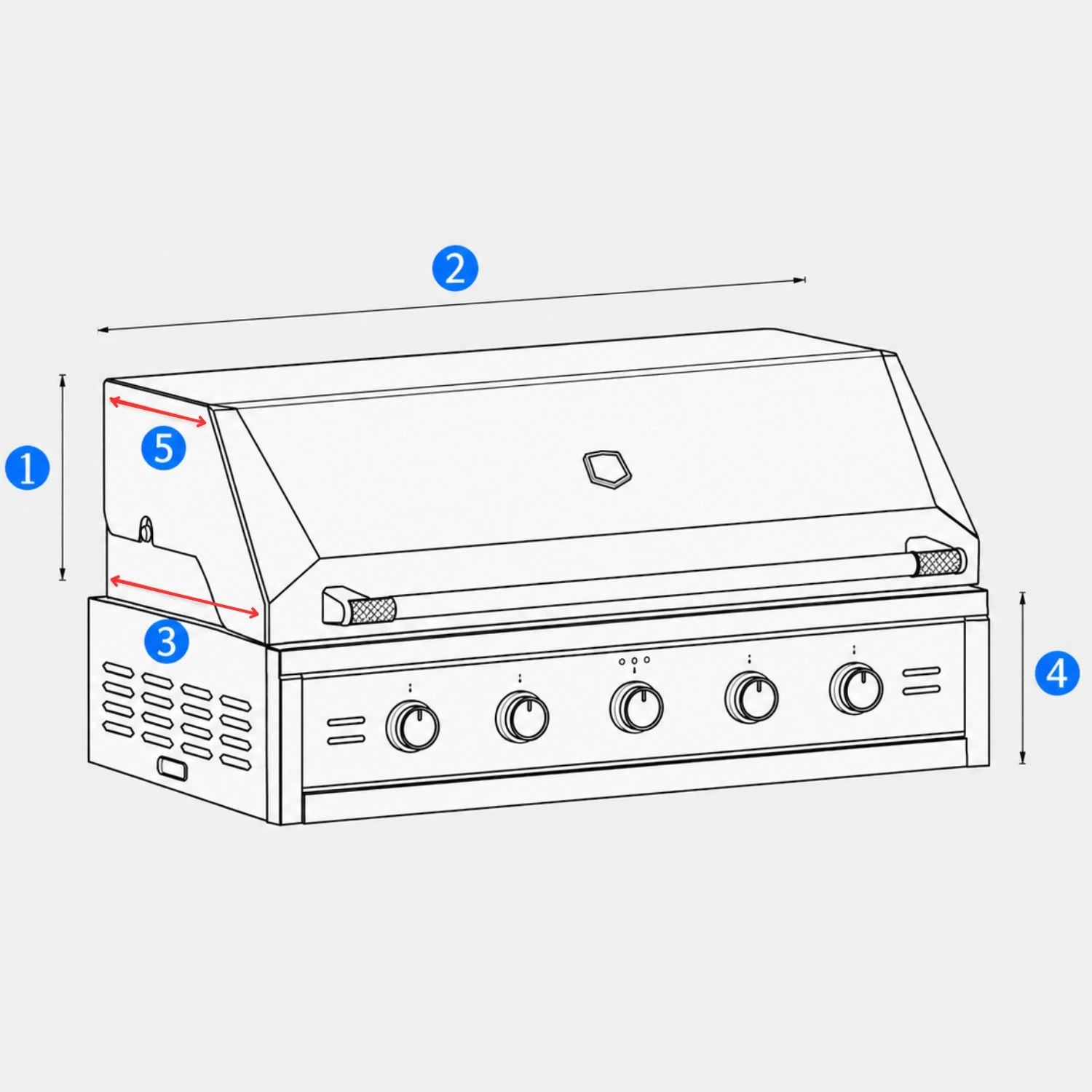
The three measurements you need
Getting the measurements right for a built-in BBQ cover takes a few minutes and a tape measure. The key is to measure the BBQ unit, not the bench it sits in.
Width
Width is the full outer dimension of the BBQ head unit from its left edge to its right edge. Measure at the widest point of the unit itself. If your BBQ has an integrated side burner that shares the same frame and housing, include that in your width measurement. If the side burner is a separate unit built into the bench beside the main BBQ, leave it out of this measurement.
Do not measure the bench cutout or the surrounding cabinetry. The cover goes over the outside of the unit, so the outer edge of the unit is your width.
Depth
Depth is front to back across the BBQ head unit. On most built-in BBQs this is consistent across the whole unit. Check for rear handles or mounting brackets that extend behind the main body, and include those if they protrude more than a couple of centimetres.
Again, this is the depth of the BBQ unit, not the depth of the bench. Those two numbers are often quite different.
Height
Height is measured from the top surface of the surrounding bench up to the highest point of the BBQ lid in its fully closed position. This is different from how you measure a freestanding BBQ, where you measure from the floor up. For a built-in, the bench surface is your starting point because that is where the cover sits.
Why material quality matters here
Built-in BBQs in outdoor kitchens tend to be higher-end units. They are worth protecting well.
The face fabric on every cover we make is 200gsm solution-dyed polyester. Solution-dyed means the colour pigment is added to the polymer before the fibre is formed, so the colour runs all the way through each thread rather than sitting on the surface. That is what makes it fade-resistant in Australian conditions, where surface-dyed or printed fabrics become patchy and chalky within two or three seasons of summer UV.
The underside carries a flexible polyurethane waterproof coating. This is important for a BBQ cover because the unit goes through repeated heat cycles during use. A rigid coating like PVC will crack at the fold lines when the cover is taken on and off. Polyurethane stays flexible and does not break down in heat.
The stitching is double-stitched at all seams. The seam is the most common failure point on outdoor covers, particularly at the corners where stress concentrates. Double-stitched seams hold together through years of use without splitting.
Caring for your cover
Rinse the outside with a garden hose every couple of months to clear dust, pollen, and any cooking residue that has settled on the surface. Shake off any loose debris before placing the cover on the BBQ.
Always make sure the BBQ is fully cold before covering it. A warm or hot unit traps heat and moisture under the cover, which accelerates rust on the grates and cooking surfaces and can damage the cover over time. Wait at least an hour after the last use.
If the inside of the cover picks up grease or fat from the BBQ surfaces, spot-clean with warm soapy water and let it air dry completely before putting it back on. Do not put the cover in a washing machine. A single wash cycle is enough to break down the waterproof coating.