The Complete Guide
Custom Made Curved Lounge Covers — The Australian Owner's Complete Guide
Curved outdoor lounges have become a popular choice in Australian outdoor living spaces over the past several years. The crescent or arc shape is visually striking, and it creates a natural seating arrangement that works well around a central coffee table or fire pit. The problem is that a curved lounge is one of the hardest pieces of outdoor furniture to find a cover for.
Why curved lounges cannot be covered with a standard cover
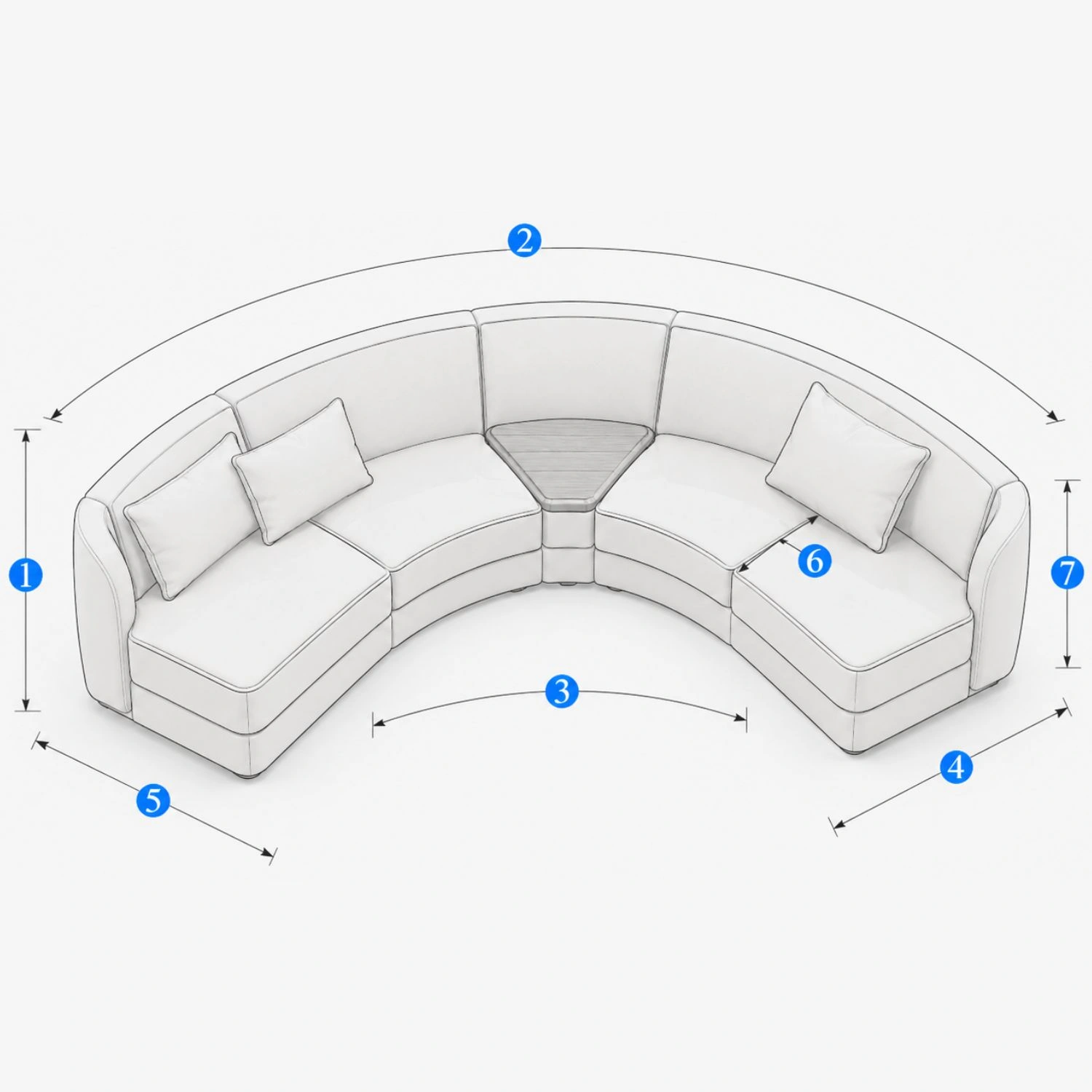
A standard outdoor lounge cover is built for a straight sofa. It has a rectangular footprint, a flat front edge, and vertical sides that drop straight down. A curved lounge has none of these. The front edge follows the arc of the seating, which means it is longer than a straight line drawn from one end to the other. The back curves inward. The seat depth varies from the centre to the ends.
Putting a rectangular cover over a curved lounge creates two problems. At the ends, where the arc pulls back, the cover has too much fabric and it bunches or gathers. At the centre, where the seat pushes forward, the cover may not reach the ground properly. The result is a cover that looks wrong and does not protect the lounge the way it should.
A curved lounge cover needs to be made from a shaped pattern. The front edge must follow the arc, the seams must accommodate the curve, and the overall dimensions must be taken from the actual geometry of the lounge.
The three measurements you need
Measuring a curved lounge takes a little more care than measuring a straight sofa, but it is straightforward once you understand the approach.
Length — the chord measurement
Length is not measured along the curve. It is the chord: the straight-line distance from the outer end of one armrest to the outer end of the other, as if you drew a straight line across the opening of the arc. Stretch your tape measure from one end to the other without following the curve. This is the dimension we use to set the width of the cover pattern. The chord will always be shorter than the arc length of the lounge, and that is correct.
Depth
Depth is measured at the deepest point of the lounge, which is the centre of the arc. Hold your tape from the back of the lounge to the front edge of the seat cushion at the middle of the piece. The ends of a curved lounge are shallower than the centre, so always measure at the centre. This gives us the depth we need to build the cover so it sits flat on the seat and reaches the ground evenly.
Height
Height is from the floor to the top of the back cushions in their normal upright position. Do not compress the cushions when measuring. The cover goes over the top of the back, so measuring with cushions relaxed gives the correct height.
Do not add extra centimetres to any of these measurements. The production pattern includes the correct ease for the cover to go on and off without pulling.
Why curved covers cost more to make
The complexity factor in the pricing for a curved lounge cover reflects the additional work involved in producing one. A straight sofa cover is built from flat rectangular panels that are sewn together in a straightforward sequence. A curved lounge cover requires a different front panel pattern for every size. The curved seams at the front corners — where the arc meets the side panels — need to be shaped and sewn precisely so the cover follows the arc without pulling tight or leaving slack. There is also an extras base charge that covers the additional seam work at the curved corners.
The fabric and the waterproof construction are identical to every other cover we make. The higher price is purely about cutting and construction time.
Material and construction
All covers are made from 200gsm solution-dyed polyester with a polyurethane waterproof coating bonded to the underside. Solution-dyed fabric holds its colour through years of UV exposure because the pigment is part of the fibre, not a surface treatment. The PU coating stays flexible through cold winters and does not crack along fold lines the way older PVC coatings do. All seams are reinforced, and the curved seams at the front corners are double-stitched for added durability.
Caring for your cover
Rinse regularly with a garden hose to clear dust, pollen, and bird droppings. Spot-clean with mild soapy water and a soft cloth. Avoid machine washing — a single cycle is enough to break down the waterproof coating. When storing the cover, fold it loosely. Tight compression along the same fold lines repeatedly can cause the coating to wear at those points over time.