The Complete Guide
Custom Made Outdoor Lounge Chair Covers — The Australian Owner's Complete Guide
Outdoor lounge chairs are used in almost every configuration of Australian outdoor living — on front porches, balconies, around pool areas, in gardens, and on alfresco decks. They tend to stay outside year-round, and because they come in such a wide variety of shapes and sizes, finding a cover that actually fits is genuinely difficult.
Why standard covers rarely fit an outdoor lounge chair
The outdoor furniture market has settled on a small number of standard cover sizes for chairs. These tend to be based on the most common mass-market chair dimensions, which means a cover sized for a 65 cm wide chair may be close to what you need but not quite right for a 72 cm wide tub chair. Close does not work well when it comes to furniture covers. Too wide and the cover drapes on the ground and collects water. Too narrow and it pulls tight across the seat and does not drape to the ground at the back.
A made-to-measure cover is built to the specific width, depth, and height of your chair. It goes on cleanly, drapes the right distance on each side, and does not have excess fabric to pool or catch wind.
The three measurements you need
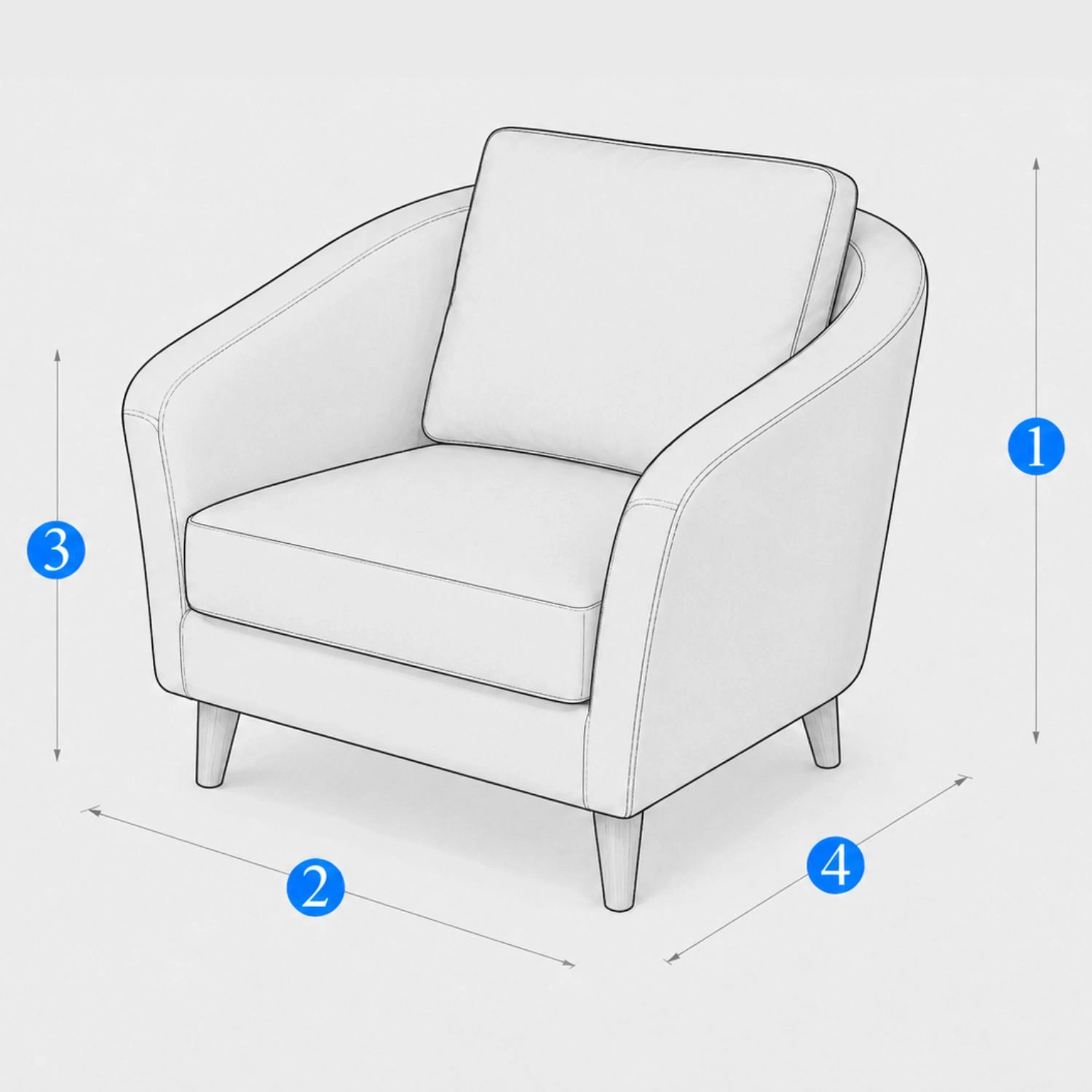
Three measurements are all that is needed to produce a cover for a lounge chair. They take about two minutes to take with a tape measure.
Width
Width is measured from the outside edge of one armrest to the outside edge of the other. Hold the tape at the widest point — if the armrests are wider than the seat frame, use the armrests. If your chair has no armrests, measure from the widest point of the seat or the outer edge of the back uprights. If the base of the chair is wider than the upper section, use the base width.
Depth
Depth is the front-to-back measurement at the deepest point of the chair. Start at the back of the frame or base, whichever protrudes furthest back, and measure to the front of the seat cushion or the front of the base. On a tub chair, the seat base may protrude forward slightly beyond the cushion — measure to the front edge of the frame, not just the cushion.
Height
Height is from the ground to the top of the chair back, measured at the highest point. If the back has a decorative peaked or arched top, measure to the peak. If the chair has a flat top back rail, measure to the top of that rail. Measure with cushions in their normal position if they are attached or if you plan to leave them on.
Do not add extra centimetres to any measurement. The production pattern includes the correct ease for the cover to go on and off without being tight.
Lounge chair versus sun lounge: choosing the right product
This product is for upright outdoor lounge chairs — the kind you sit in at a right angle, with a vertical back. Tub chairs, accent chairs, occasional chairs, and outdoor armchairs all fall into this category.
A sun lounge is a completely different piece of furniture. It is designed for lying down, with a reclined back and an extended seat. Sun lounges need a different cover shape entirely — one that is long and low rather than compact and tall. If your furniture is designed for lying on, check our sun lounge cover product instead.
Covering a pair of chairs
Many people buy lounge chairs in pairs, and covering them individually is often the most practical approach. Each chair gets its own cover, which means you can cover and uncover them one at a time without moving furniture. Ordering two covers is straightforward: just set the quantity to two before submitting your quote.
Material and construction
All covers are made from 200gsm solution-dyed polyester with a polyurethane waterproof coating on the underside. Solution-dyed polyester holds its colour far longer than conventionally dyed fabric because the pigment goes into the fibre during production. In Australian conditions, where UV exposure is intense for much of the year, the difference is noticeable after the first summer or two of regular use.
The PU coating on the underside is flexible and stays that way through cold winters, unlike older PVC coatings which tend to crack at fold lines after a season or two. Seams are reinforced throughout, and the base hem has enough structure to sit in position in light winds without needing to be tied down.
Caring for your cover
Rinse with a garden hose every couple of months to remove dust, pollen, and bird droppings. Spot-clean with mild soapy water and a soft cloth. Do not machine wash — a single cycle removes the waterproof coating. Fold loosely for storage rather than compressing tightly, and keep in a dry spot if storing away for a season.