The Complete Guide
Custom Made Patio Heater Covers — The Australian Owner's Complete Guide
A freestanding patio heater is built to handle outdoor use, but the components that make it work — the control valve, gas fittings, and reflector coating — are all vulnerable to prolonged weather exposure when the heater is not in use. This guide covers how to measure and care for your cover.
What a patio heater cover protects
The reflector head is the most obvious part to protect. It is usually a polished or coated metal dome that reflects heat downward. Prolonged rain exposure causes the coating to pit and corrode, which reduces the reflective efficiency of the head over time.
The gas fitting and control valve at the base of the pole are the most mechanically critical points to protect. Rain sitting in or around a gas connection can cause corrosion to the fitting threads, which makes the connection harder to seal properly. Any compromise to a gas fitting is a safety concern, not just a maintenance issue.
The pole itself is usually stainless steel or powder-coated steel. Stainless is corrosion-resistant but not immune, particularly in coastal environments. Powder-coated steel can rust through chips or scratches in the coating. A cover keeps moisture away from the whole assembly.
Two measurements
Diameter
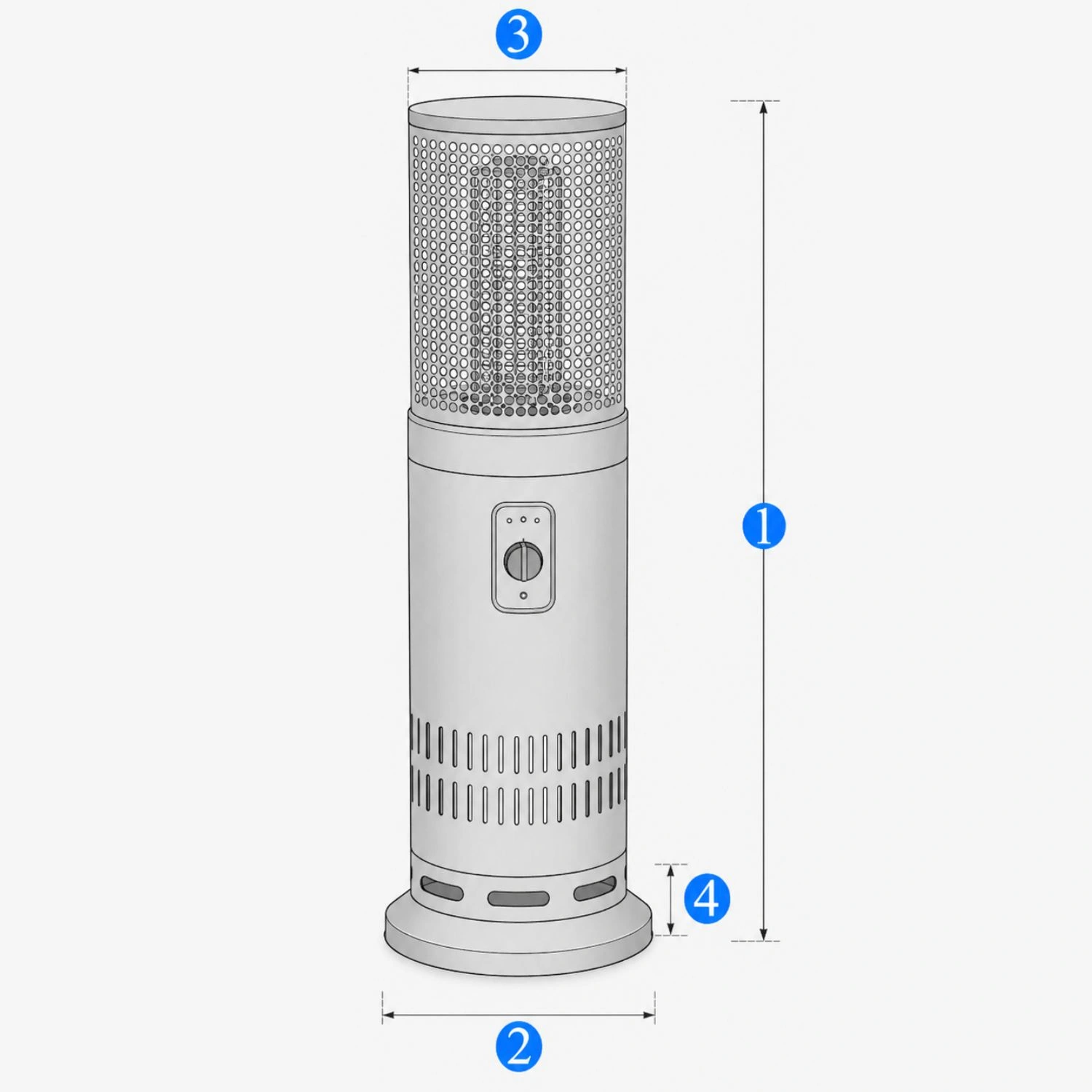
Diameter is always measured at the widest point of the heater. On a mushroom-style patio heater, that is the reflector head at the top.
Measure from edge to edge across the widest point of the head. This is the measurement the cover needs to accommodate first, since the cover goes on from the top down. If the cover fits over the head, it will fit over the narrower pole below it.
Heater head diameters vary between brands. A standard mushroom heater might have a head of 55 to 70 cm across. Measure yours directly rather than assuming.
Height
Height runs from the ground to the very top of the heater unit. Include the full height of the head. The cover needs to reach from the top of the head down to the base to protect the gas valve and connection.
Safety note
Never fit a cover on a heater that has recently been in use. The reflector head holds heat for a long time after the heater is switched off. A minimum of one hour is a sensible waiting time in normal conditions. On very hot days or after extended use, wait longer.
Covering a hot heater traps heat inside the cover. This risks damaging the fabric, the reflector coating, and in extreme cases can create a fire hazard. When in doubt, place your hand near the head (without touching it) to check for residual heat before fitting the cover.
Material
The cover is made from 200gsm solution-dyed polyester with a waterproof polyurethane underside. The cylindrical shape of a mushroom heater cover requires additional seam construction compared to a flat rectangular cover, which is why it uses a slightly higher complexity factor in the pricing formula. The material itself is the same as every other cover we make.
The PU underside keeps rain from reaching the heater surface. Water runs off the outside of the cover rather than pooling against the metal components.
Care
Fit the cover whenever the heater will be unused for more than a day or two. For outdoor heaters that live outside year-round, the cover goes on every time the heater cools down after use.
Rinse the cover with a hose occasionally to clear dust and residue. If salt spray or industrial dust is present in your area, rinse more frequently. Do not machine wash. Spot clean any marks with warm water and a cloth, and allow to dry fully before refitting.