The Complete Guide
Custom Made Rectangle Table Covers — The Australian Owner's Complete Guide
A rectangular outdoor dining table is one of the most common pieces of garden furniture in Australia, and one of the most straightforward to cover when you have the right measurements. This guide covers everything you need to know before ordering a custom cover for your outdoor dining table.
Why standard covers rarely fit well
Outdoor table covers are typically sold in a handful of fixed sizes — 150 cm, 180 cm, 210 cm, and occasionally 240 cm in length. The problem is that table manufacturers work in completely different size increments. A table that is 195 cm long does not fit a 180 cm cover without leaving the ends exposed, and a 210 cm cover will hang 15 cm too long on each end.
Width is an equally common issue. A standard cover made for a 90 cm deep table will sit wrong on a table that is 95 cm or 100 cm deep. The cover either pulls tight across the tabletop instead of draping properly, or it is wide enough to drape but creates a baggy section on the narrower sides that collects water and wind.
Getting a cover made to the actual dimensions of your table fixes both problems at once.
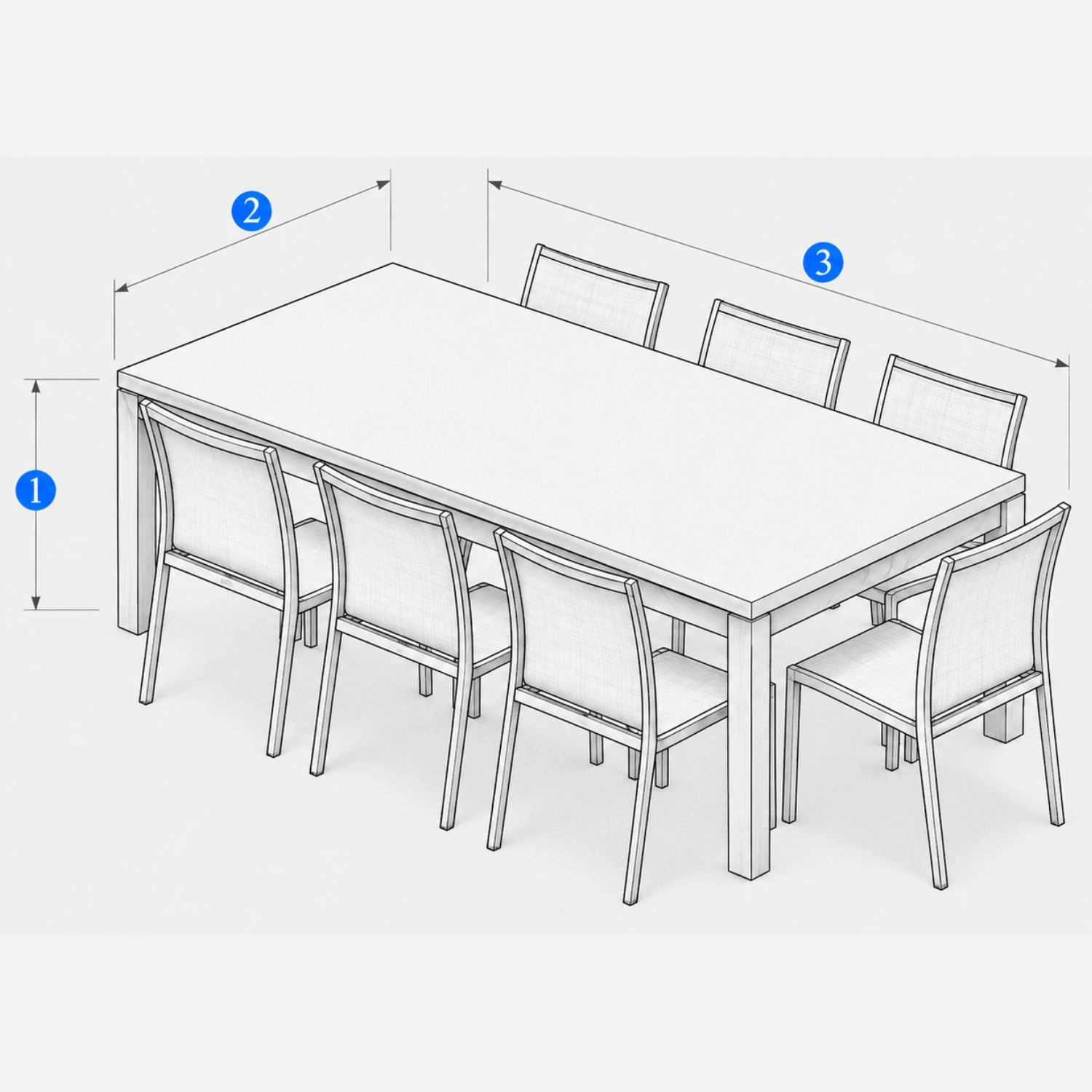
The three measurements you need
Width
Measure the longest side of the tabletop from outside edge to outside edge. This is the measurement you are probably used to when describing the table — a 2.1 metre table, or a 1.8 metre table.
If the tabletop has a decorative edge, a lip, or a frame that extends beyond the main surface, measure to the outer edge of that feature. The cover needs to clear the full width of the top.
Depth
Measure the shorter side of the tabletop from outside edge to outside edge. This is the front-to-back measurement when you are sitting at the table. As with width, measure to the outer edge of any lip or frame.
If your table is square rather than rectangular, one side will be width and the other depth — they will be the same number, which is fine. Just enter the same measurement in both fields.
Height
Measure from the floor to the top surface of the tabletop. This determines how far the cover drops from the tabletop edge to the ground on all four sides.
Do not measure to the top of the umbrella fitting, any central column, or anything that sits above the tabletop. The relevant height is floor to the main table surface. The cover is patterned to drape to the ground from that point — you do not need to calculate or add the drape allowance yourself.
Covering a table between seasons
A rectangular dining table that is used regularly during the warmer months and then left uncovered through autumn and winter will age several times faster than one that is protected. The combination of UV, rain, and the cycle of wet and dry wears down finishes, rots timber, corrodes metal, and fades fabric that you would otherwise get many more years from.
A cover that reaches the ground on all four sides is the key detail. A cover that stops at the tabletop level protects the surface but leaves the legs, stretchers, and base exposed to everything from the sides and below. A ground-draping cover protects the whole structure.
If your table lives in a covered outdoor area or under a pergola, a cover is still worthwhile. Damp air, condensation, and indirect rain all cause damage over time. The cover also keeps dust, bird droppings, and debris off the surface, which means less cleaning before each use.
Large tables and getting the measurements right
For six, eight, and ten-seater tables, the width measurement in particular is worth taking twice. A measurement that is out by 10 cm on a large table will result in a cover that either pulls tight across the top or has a visible sag on the long sides. Take the measurement at the tabletop surface level and again at the underside of the tabletop to check consistency — on most tables they will be the same, but some designs have a frame that extends beyond the top surface at the edge.
If your table has leaves that extend the length, measure with the leaves either in or out depending on the configuration you most commonly store it in. A cover should fit the table as it is normally left when not in use, not every possible configuration.
Material
The face fabric is 200gsm solution-dyed polyester, which means the pigment is part of the fibre rather than applied on top. This is why it holds its colour through Australian UV conditions where surface-dyed materials go patchy and faded within two or three seasons.
The underside carries a flexible polyurethane waterproof coating. It sheds water cleanly, stays flexible across temperature extremes, and does not crack at fold lines the way stiffer coatings do. Both layers are UV stabilised.
Caring for your rectangle table cover
Rinse the outside of the cover with a garden hose every month or so, and always after a heavy rain or dust period. Shake off debris before putting the cover on — grit trapped between the cover and the table surface can scratch both over time.
Spot-clean any marks with warm soapy water and allow to dry fully before putting the cover back on. Do not machine wash — the agitation breaks down the waterproof coating in a single cycle. When storing the cover, vary the fold lines rather than folding in the same place each time.